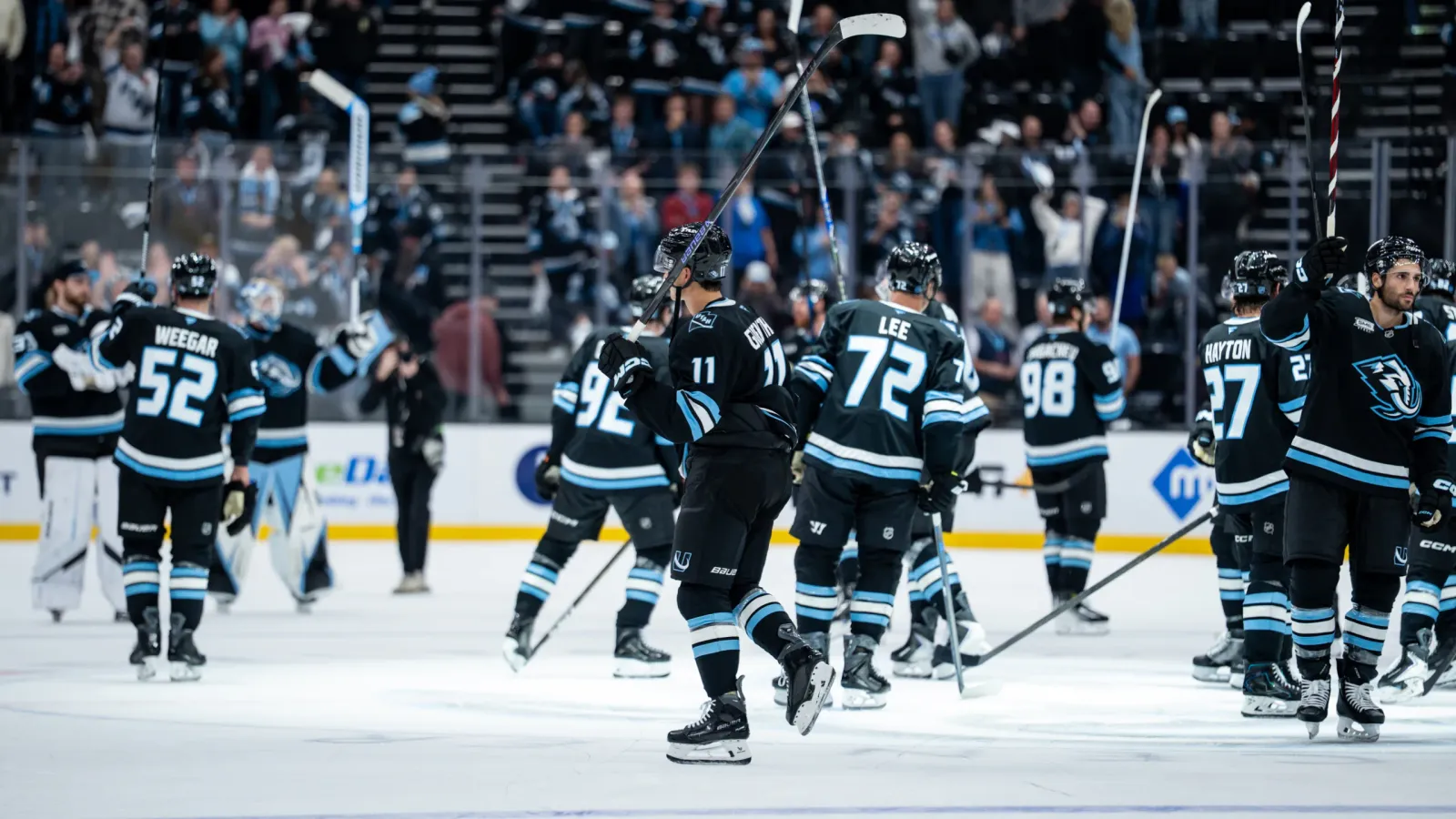
A r/Utah_Hockey thread this week passed around the lines the Mammoth practiced with: Kailer Yamamoto with Logan Cooley and Dylan Guenther, and a third line of Barrett Hayton, Vincent Trocheck and Anders Lee. The mood was close to relief. One fan wrote that "Yams-Cooley-Gunner was our best goal-scoring line at the end of the year last year." Another admitted that a winger listed at 5'9" and 160 pounds is "the very last guy you'd think would make sense" next to them, and still wanted it.
We checked it against the NHL's shift charts, and the line fans are asking for hasn't been the line Utah plays. In the games we can see, Yamamoto, Cooley and Guenther were never on the ice together at five-on-five. The Yamamoto line that works has been somewhere else.
What the shift charts show
The NHL has shift data posted for three of Utah's seven games, Boston, Buffalo and Toronto, so everything below comes from those three. That's a small sample, and it's all we can responsibly use. We matched each five-on-five shot attempt to the forwards on the ice. Shift times are whole seconds, so very short overlaps are approximate.
Yamamoto and Cooley shared the ice for about two minutes of five-on-five time across Buffalo and Toronto, almost all of it handoffs at line changes. Yamamoto and Guenther overlapped for about a second. When they did, Guenther scored with an assist from Yamamoto. A one-second sample proves nothing, but it's the only one there is.
The lines that actually played:
- Lee, Yamamoto and Hayton: 16.9 minutes at five-on-five in Buffalo and Toronto. Utah took 31 shot attempts to seven and 11 shots on goal to one while they were out there, and scored two goals without allowing any. Both goals came in Buffalo.
- Trocheck, Guenther and Cooley: 20.1 minutes in the same two games. Attempts were 20-21 and shots on goal 8-10 against Utah, with one goal for and none against.
- Lee, Guenther and Cooley: 8.7 minutes in Boston, when Yamamoto wasn't in the lineup. Attempts were 9-6 for Utah and shots on goal 2-4, with no goals for and one against.
In Toronto the Lee line was the most one-sided on the ice: 15 attempts to two and six shots to one in 9.3 minutes. It produced no five-on-five goals that night, so the Maple Leafs game didn't turn on it, but the process was the best of any Utah forward group.
Why this matters for the argument
The fans' case rests on last season, and we can't test that. We don't have last year's shifts, and the thread's claim that this was Utah's best scoring line is the fans' recollection, not ours. What we can say is that the early-season version of the idea, put Yamamoto's energy next to the young scorers, hasn't been tried in any game with shift data. The coaching staff put him with Lee and Hayton and has left him there.
Cooley and Guenther, for their part, were fine in Buffalo and Toronto with Trocheck, not great. They scored, and the attempts were close to even. One fan in the thread, who has watched more of this than we have, said "in practice it's very hard to find the right player to pair with Cooley and Guenther even though it doesn't seem like it should be." The ice time says the same thing. Utah has tried Lee, then Trocheck, and neither has made the pair dominant.
Hayton is the common thread on the line that works. He has four assists in these three games: one on Jack McBain's goal in Boston, two in Buffalo (Yamamoto's goal and Marino's power-play goal), and one on Mikhail Sergachev's goal against Toronto. That's a small number, but his line is the one driving shots.
The decision in front of Utah
If Tourigny moves Yamamoto up with the young scorers, he breaks up the line that's outshooting teams 11-1, and he'd be doing it to chase a number we can't confirm from last season. If he leaves things alone, the Trocheck, Guenther and Cooley line stays a coin flip. We'd leave Lee, Yamamoto and Hayton together and look for a different fix for the top-six wing, not take apart the group with the best numbers. Michael Carcone, who is week to week according to a separate thread, complicates that, since the fans' second question was where he fits when healthy.
We don't know why the staff skated the Yamamoto-Cooley-Guenther line in practice and then didn't use it. Practice lines are often just a look. The next chance to see whether it appears is Thursday in Edmonton.
Tusks up.
Sources: NHL.com play-by-play and shift charts for Utah's games at Boston, Buffalo and Toronto (line combinations, shot attempts and shots on goal at five-on-five are our analysis; shift charts weren't available for the first four games; see our Bruins and Sabres recaps), and the r/Utah_Hockey lines thread.