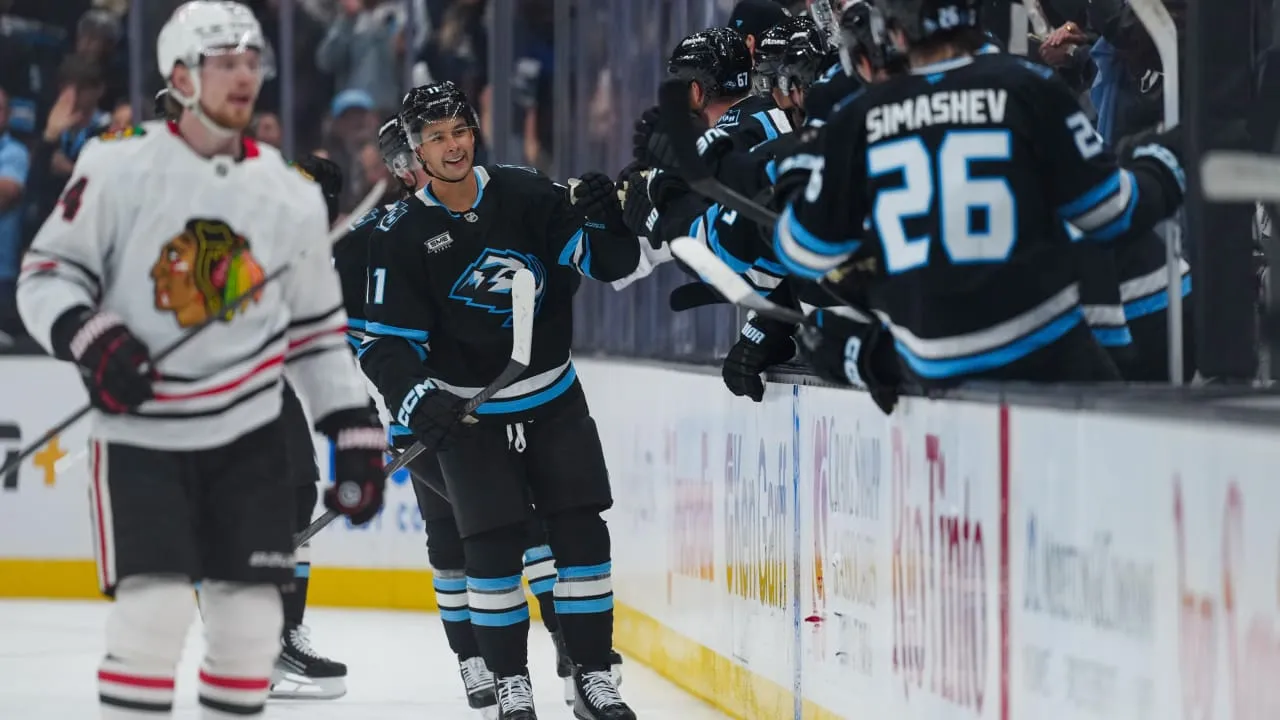
Karel Vejmelka will get the credit for the first home shutout in franchise history, and the Delta Center chanting "Veggie" is a good way to spend it. But the number that explains Utah's 6-0 win over Chicago on Oct. 1 is three. That's how many shots the Blackhawks got from inside 25 feet all night, going by the NHL's play-by-play tracking. The Mammoth got 13.
Chicago's 15 shots on goal came from an average of about 47 feet out, and nine of them were from 40 feet or more. Utah's averaged about 30. The attempt totals tell the same story from a different angle: Utah 65, Chicago 42, and 23-10 in Utah's favor before the first goal even went in at 16:41 of the first period. Look at who was shooting, too. Chicago's defensemen took 19 of their 42 attempts, which is what a team does when it can't get anything going from the middle of the ice. Utah's defensemen took 17 of 65.
Head coach André Tourigny said it plainly afterward: "we kept them on the outside." It sounds like coachspeak until you see the shot map.
The goals came from the same place
Four of Utah's six goals were scored from inside 15 feet, and three were logged as tip-ins. Tourigny said as much about his team's approach: "A lot of our goals were through traffic." The defensemen fed it. Sergachev missed the net at 9:45 of the second, and Schmaltz scored from about six feet two seconds later. Andrew Peeke's shot set up Anders Lee, who scored in his Mammoth debut at 13:06, and Tourigny singled it out: "I think Peeker brings physicality and took a great shot on Andy's goal." Nate Schmidt had the other defenseman assist, on Daniil But's tip-in in the third.
The power play fit the same pattern. Dylan Guenther scored his first from the high slot about 32 feet out, 48 seconds after Artyom Levshunov went off for holding. His second came from six feet, in front, with Keller and Lawson Crouse setting it up. Utah went 2-for-3 with the man advantage and 3-for-3 killing penalties, and 14 skaters finished with a point, a franchise record according to the team.
Barrett Hayton led Utah with eight shot attempts and finished without a point, which is a good example of a night where the process ran ahead of the results. The broader picture agrees with it. Deseret News reported, from Natural Stat Trick, that roughly 80 percent of the high-danger chances belonged to Utah.
What Veggie actually did
If you count by danger, Vejmelka's night comes down to three saves. Chicago's only shots inside 25 feet were a snap shot from about 23 feet at 8:04 of the first period and two backhands from 13 and 14 feet at 8:57 and 9:03 of the third, with the game already 5-0. He stopped all three.
Tourigny's line on the goalie was "When he had to come up big, he made the big save." Both halves of that sentence are true. The fair way to say it is that Vejmelka was sharp when it counted and rarely had to be. The credit for the 15-save shutout is shared with the five skaters in front of him, who gave up very little.
The Chicago side, and where we'd push back
Vinnie Parise of The Hockey News wrote that "Chicago had no answers for Utah in the defensive zone," pointed at the Alex Vlasic and Bowen Byram pair, and noted six Chicago forwards didn't put a shot on goal. All true. We'd add the other half: Chicago also couldn't get into Utah's zone with anything dangerous, and those two problems feed each other.
Context matters, too. Teuvo Teravainen was in the lineup for the injured Andrew Mangiapane, per Parise, and Connor Bedard wasn't on Chicago's game roster in the NHL data. We couldn't find out why. One fan on r/Utah_Hockey put it this way: "It had a bit of a varsity vs JV vibe." A short-handed Chicago explains some of it. It doesn't change who owned the inside of the ice.
The same thread had a different complaint: "Half the goals were no screen or anything and should be saves." We don't buy it. Four of the six came from inside 15 feet, and one was off a puck that, per the AP, bounced off Soderblom's own skate. That's a tough night for a goalie, but he wasn't the main reason Chicago lost.
What this does and doesn't tell us
It's one game, against a team missing pieces, so none of this is a verdict on Utah. What the opener does show is a team playing the way its coach says he wants: shots from the back end into traffic, the net-front areas crowded, and almost nothing allowed in the middle. Keller put the plan in his own words after the game: "We talked about that a lot, and trying to take away their time and space."
The next test comes quickly: five games on the road, starting Saturday in Columbus. If the shots-inside-25 split looks anything like 13-3 against better teams, that's a real sign. If it doesn't, we'll know the opener was more about Chicago.
Tusks up.
Sources: NHL.com game story (Utah Mammoth), NHL.com box score and play-by-play data (shot locations and types are our analysis of the NHL's coordinates, so treat distances as approximate), Deseret News, The Hockey News, AP via KUTV, r/Utah_Hockey postgame thread.