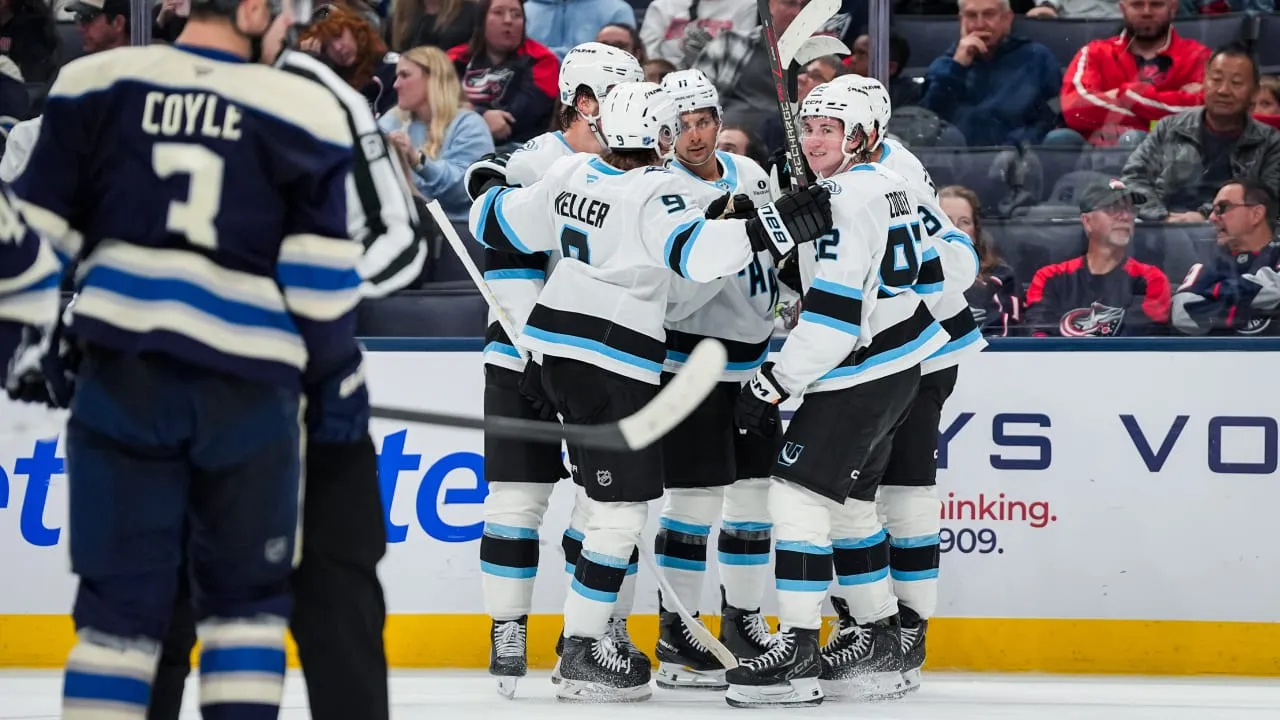
The Mammoth beat Columbus 4-1 at Nationwide Arena on Saturday, and the easy takeaway is that the team looked dominant again. It did on the power play. It didn't at five-on-five, and the easiest way to see that is to take away the three power-play goals. Without them, this game is 1-1.
Utah went 3-for-4 with the man advantage, scoring 70 seconds, 16 seconds, and 50 seconds after Columbus went to the box. Sergachev, Guenther, and Schmaltz each got one, and the unit is 5-for-7 through two games, which the team says ties a franchise record for power-play goals in a two-game span. Columbus had two power plays of its own, and Utah killed both.
Five-on-five was a different game from the opener
The 6-0 win over Chicago was lopsided at even strength: 59 attempts to 38, and 11 shots on goal from inside 25 feet to three. Saturday's NHL data looks different. At five-on-five Utah led in attempts, 56-46, and in shots on goal, 22-17. But on the shots that matter most, Columbus had eight from inside 25 feet to Utah's seven. In the second period the teams were even on shots on goal (7-7) and Columbus led in attempts, 20-17.
Head coach André Tourigny described it himself: "The second period was not as good for us at five-on-five because we try to make extra plays, and we stop being direct. If you want to play fast, you need to go quickly. If you take your time to wait for the next best opportunity, we're not as fast, and then we allow the other team to settle a little bit." The play-by-play has an example. Kent Johnson's goal at 1:30 of the second, a snap shot from about 25 feet, came six seconds after Vincent Trocheck gave the puck away in Columbus's end.
Nick Schmaltz, to Deseret News, gave the same read from the ice: "First half, they were on us a little bit, but the second half, we really turned it up a notch and I think we tired them out, honestly."
Brian Hedger of The Columbus Dispatch wrote that Utah "dominated from nearly start to finish." That's right for the first period, when Utah had 32 attempts to Columbus's 11. The 40 minutes after that don't support it. Columbus coach Rick Bowness named the problem himself, and it was about the Blue Jackets more than Utah: "We looked slow because we turned the puck over."
The penalties decided it
Zach Werenski told NHL.com, "Penalties kind of killed us tonight." The tracking data agrees. Utah's power plays produced 14 shot attempts, eight on goal, and three goals in about four minutes of man-advantage time. Hedger noted that the tripping call on Dmitri Voronkov, before Sergachev's 54-foot slap shot, came on a play where Voronkov "pushed Mammoth forward Jack McBain to the ice without any kind of a trip." Columbus can argue that one. The other three are harder to dispute, including Denton Mateychuk's high-sticking and Emil Andrae's slashing.
Tourigny's explanation for why the power play works is simple: "They don't hang around. They go, they attack, they shoot." Schmaltz's version: "We know where (each other is) going to be at. When we're snapping the puck and we're shooting, we're really dangerous." The Hockey Writers picked the Schmaltz goal, which was also his 500th career point, as the best play of the night: he backhanded a pass to Logan Cooley and got it right back.
Our take: the power-play improvement is real, and it fixes the biggest weakness of last season. Special teams can decide a single game, though, so the better question is what the other 56 minutes look like against a team that stays out of the box.
Cossa had a busier night than he let on
Sebastian Cossa made his first NHL start in Columbus, about two and a half hours from the ECHL city where he began his pro career, and won it. The NHL box score has him stopping 18 of 19 shots, while the team's story and the NHL.com recap list 17 of 18, so you may see either number.
Cossa gave his teammates the credit: "They didn't really get any odd man rushes. Kept the seam passes away, didn't really have any high danger chances. A lot of stuff from the outside and we were beating them to the inside after that, too, so they weren't getting second chances. Made my life easy."
The shot data says otherwise. Columbus put eight shots on goal from inside 25 feet, and five were from about nine feet or closer: Sillinger from four feet, Olivier from seven, Fantilli from eight, and Johnson and Knies from nine. Johnson's goal, from 25 feet, was the only one that got through. Schmaltz called him "a calming presence" who "didn't overreact to anything," and he had a few reasons to be calm.
What this tells us
Utah is 2-0 and has outscored its opponents 10-1. Chicago and Columbus aren't heavyweights, as The Hockey Writers pointed out, so the numbers on the shot map matter more than the score. The opener showed a team that controlled the inside of the ice. Saturday showed a team that can win without doing that, as long as the power play keeps cashing in and the goalie handles the close ones.
Keller's 600th career point came on a first-period assist to Schmaltz. A fan on r/Utah_Hockey summed up the mood after two games: "This team, albeit 2 games, is doing a great job. Last year there were soooo many stretches of just letting the other team have the puck and control it." Another looked ahead: "rangers on the road back to back will be a real test."
That's the right read. Utah plays New York at Madison Square Garden on Sunday, the second night of a back-to-back, and we'll learn whether the second-period lull was a one-night problem.
Tusks up.
Sources: NHL.com game story (Utah Mammoth), NHL.com recap, NHL.com box score and play-by-play data (shot locations and strength splits are our analysis of the NHL's coordinates, so treat distances as approximate), Deseret News, The Columbus Dispatch via Yahoo Sports, The Hockey Writers, r/Utah_Hockey postgame thread.