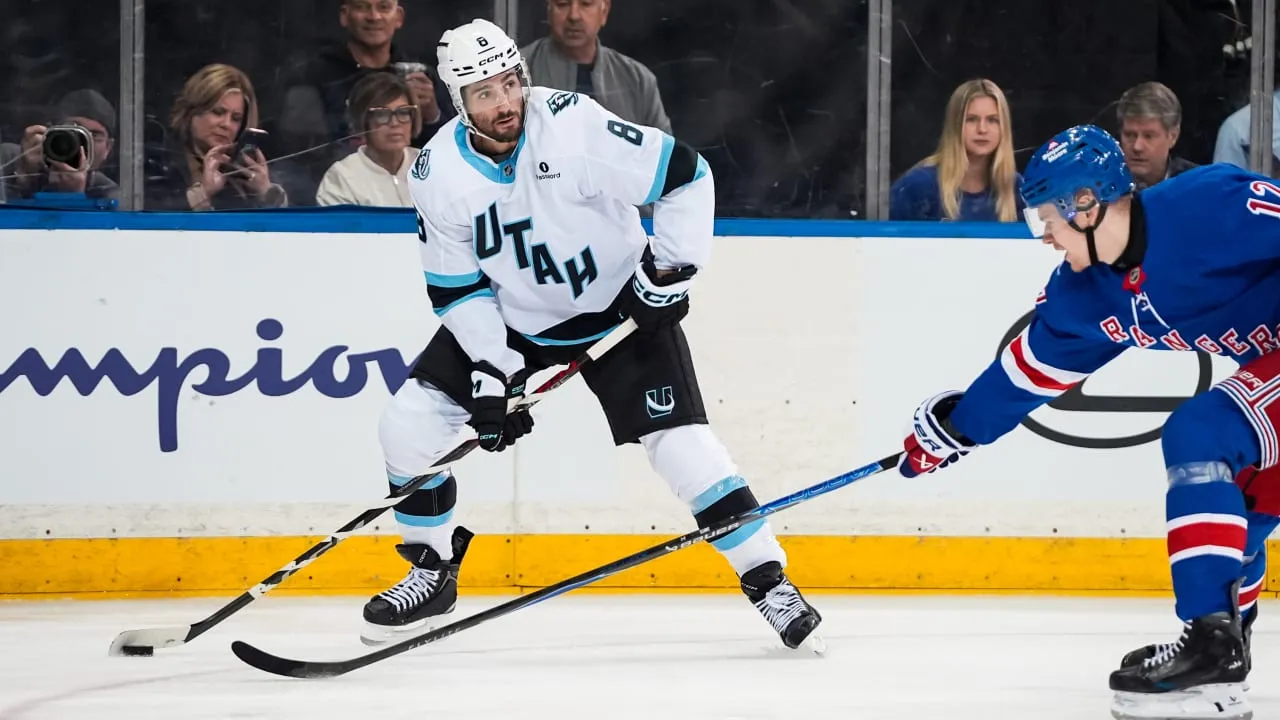
Utah lost 4-2 to the Rangers on Sunday and still led in shots on goal (30-22), shot attempts (69-55), and shots on goal in every period. The tempting read is that the Mammoth were the better team and got goalied. We'd call that too generous. The shot totals mostly describe the third period, when Utah was chasing, and in that period the shots got worse.
The even game and the chasing game
Through two periods, five-on-five attempts were 33-27 for Utah and shots on goal were 12-10. That's a fair fight, not the one Mammoth coach André Tourigny described afterward: "Through two periods we were probably doubling that team in scoring chances; that's a lot of good." We can't see the team's own chance count, and the NHL feed doesn't publish one. The NHL's coordinates have Utah with 10 shots on goal from inside 25 feet through two periods and New York with seven. That's an edge, but nothing like double.
The big numbers arrived in the third. Utah took 29 attempts to 16 and 15 shots to nine, and at five-on-five the attempts were 26-13. The third opened with a fight between Jack McBain and Cuylle at 1:03. Gabe Perreault scored at 3:15 and the Rangers were ahead for the rest of the night, so Utah was playing from behind for nearly all of it. Trailing teams shoot more. The total reads as dominance only if you ignore the clock.
Where the third-period shots came from
Utah's shots on goal in the first two periods averaged about 23 feet from the net, and 10 of 15 came from inside 25 feet. In the third they averaged about 28 feet, and only five of 15 were from inside 25. Defensemen took 15 of Utah's 40 attempts through two periods (38 percent) and 14 of 29 in the third (48 percent). Distances come from the NHL's rounded coordinates, so treat those as approximate, but the direction is clear.
This is what Tourigny meant by impatience: "it's more the mindset, we got impatient so that's something we address." It also lines up with how Utah has won the first two games. The opener against Chicago was lopsided in shots from in close. The Mammoth got there by working to the middle of the ice. On Sunday they stopped doing that once they were down a goal.
It also answers the question we left open after Saturday's win in Columbus, which was whether the second-period lull would carry over. It didn't. Utah's second period in New York was its best: 25 attempts, nine shots on goal, seven of them from inside 25 feet, and Nick Schmaltz scored on the power play 28 seconds after Will Cuylle took roughing and boarding penalties for shoving Dylan Guenther head-first into the boards.
Odd-man rushes are real, but they aren't the whole story
The Hockey Writers called the odd-man rushes the biggest issue, and Utah fans on r/Utah_Hockey noticed the same thing: "Why did they have so many odd-man rushes this game? Felt constant." The AP recap says Karel Vejmelka stopped a pair of Alexis Lafrenière breakaways, and the Perreault goal came off a Zibanejad-to-Lafrenière 2-on-1 that Vejmelka stopped before the rebound went to Perreault.
We agree those were the Rangers' best looks. Our pushback is on how much they explain. By The Hockey Writers' own count, none of the other three goals came on a rush. Two of them, as that piece describes them, came from puck-management mistakes: a failed clear by Anders Lee ahead of Vladislav Gavrikov's 59-foot shot, and Andrew Peeke running into Vejmelka before the J.T. Miller deflection. Miller's goal was a six-foot redirect of a Gavrikov point shot. Here's how he explained it: "I figure if you do it 10 times a game something will go off your foot."
We read that as a team forcing the game in the third and handing over cheap goals when it failed, which is closer to Tourigny's diagnosis than to a defense that can't handle rushes. The feed can't count rushes, so we won't put a number on them. The shot map and the goal list point at puck decisions more than at tired legs.
Legs, and the fair counterargument
Plenty of fans blamed the back-to-back, and Tourigny acknowledged the team had to work on one. The numbers don't show a fade. Utah's attempts went up every period, 15, 25, 29, and it out-hit New York 29-23. The penalty kill went 4-for-4 against four Rangers power plays, and New York managed 11 attempts and two shots on goal with the man advantage. A tired team doesn't usually do all of that. Vincent Trocheck's summary fits: "I loved our effort; execution just wasn't there tonight."
The counterargument is Igor Shesterkin, and it's a good one. He stopped 14 of the 15 shots Utah put on goal from inside 25 feet, and the only one that beat him was Schmaltz's from about 11 feet. One fan on the thread said Utah "mostly lost to Igor’s outstanding saves." Another wrote, "Outplayed and somehow the rangers won." We'd disagree with the second one. Through two periods the game was even, and New York played most of it with 11 forwards after Joe Veleno left with a lower-body injury. But the first one has a point. A third period of mostly long shots doesn't beat a goalie having a night like that.
The Rangers see the ending the same way from the other bench. They have now outscored opponents 5-1 in third periods across three games, and coach Mike Sullivan said winning those minutes comes down to "your ability to stay in the moment." Tourigny's word for the same idea was patience.
The result changes little in the standings, and The Hockey Writers is right that this was really a 3-2 loss with an empty-netter added. What matters is the habit. The Mammoth are 2-1 with a power play that has scored in all three games, a penalty kill that held up, and a second-period lull from Saturday that didn't recur. The thing to watch is the next time they're down a goal at five-on-five, and whether they keep getting to the middle of the ice or start taking long shots again. Utah is in New Jersey on Tuesday.
Tusks up.
Sources: NHL.com game story (Utah Mammoth), NHL.com recap, NHL.com box score and play-by-play data (shot locations, periods, and strength splits are our analysis of the NHL's coordinates, so treat distances as approximate), The Hockey Writers, AP via KUTV, r/Utah_Hockey postgame thread.