In an interview KSL Sports Zone 97.5 posted Friday, Mammoth owner Ryan Smith said Logan Cooley got to five career hat tricks faster than anyone in NHL history. The real number doesn't need the help. Thursday's three goals in Montreal were Cooley's fifth hat trick, in his 228th NHL game, and NHL.com's game story by Sean Farrell calls him "the fastest active player to record five hat tricks," ahead of Alex Ovechkin at 230. Two of the five have come in his last four games. Owners are allowed to round up. We'll stick with "active."
The more useful thing Smith said was about the team. He told KSL Sports Zone 97.5 the Mammoth aren't close to their potential yet. He's right, and the power play is the reason it's easy to miss how far off they are. It's covering two holes.
What the power play is hiding
Utah's power play is first in the NHL at 38.3%, 23 goals on 60 chances through 17 games, and it has given up one shorthanded goal. Last season it ran at 20.0%, 18th in the league. Those 23 goals are more than a third of the 61 Utah has scored.
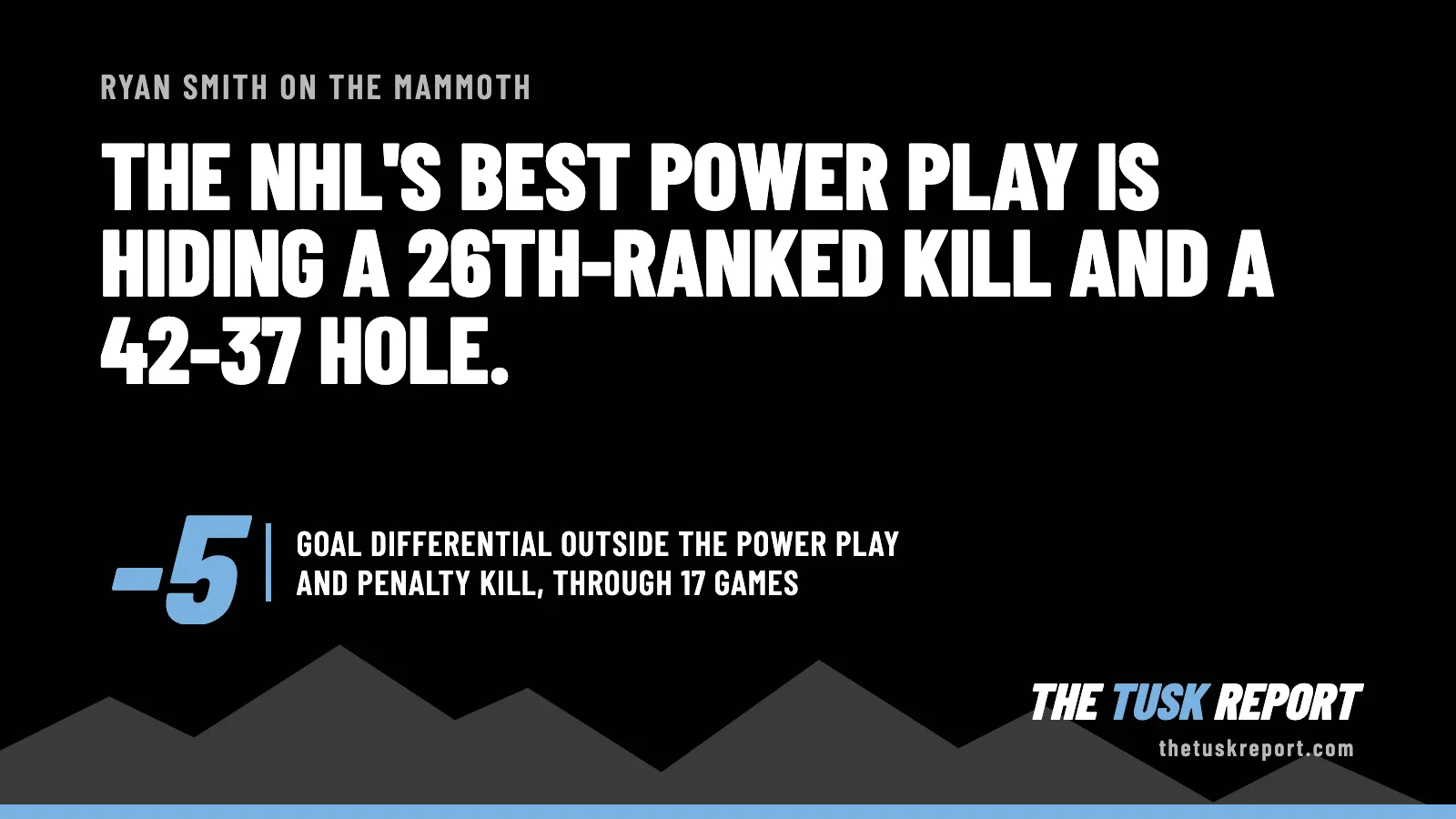
The first hole is the penalty kill. It's 26th at 70.4%, with 16 goals allowed in 54 times shorthanded. Count the one shorthanded goal each way and special teams have Utah at plus-7 for the season, with the kill giving back 16 of the power play's 23.
The second hole is the one the power play can't touch. Outside the power play and penalty kill, which covers five-on-five, four-on-four, overtime and empty nets, Utah has scored 37 goals and allowed 42. That's minus-5 whenever neither team is on a power play.
Together they leave an odd pair of numbers. Utah allows 3.47 goals a game, 25th in the league, so only seven teams give up more. It also allows 25.4 shots a game, the eighth-fewest.
What it costs in the standings
Utah is 10-6-1 with 21 points, fourth in the West. That's by points; by points percentage, .618, it would be sixth. Goal differential is plus-2: 61 for, 59 against. Special teams are plus-7, so they account for all of that plus-2 and then some.
We wouldn't bet on a 38.3% power play lasting the whole season. When it cools, the plus-7 shrinks and the minus-5 is still there.
Thursday in Montreal was the pattern in one night. The power play went 3 for 5 and the kill allowed one goal on Montreal's four chances, a good night at both ends. Montreal won five-on-five 3-1 in goals, as our recap laid out, and won 5-4 in overtime.
The rest of the sheet looks like a better team than fourth. Utah scores 3.59 goals a game, eighth in the league, and puts 29.7 shots a game on net, sixth. The pieces are there; the kill and the minus-5 keep them from adding up.
Smith's long view
Smith sounded patient. He said the veterans Anders Lee and Vincent Trocheck are finding their rhythm and the group is still learning to play together, and he said this group will be good for a long time. With Cooley 228 games into his career, we won't argue.
Our ask is for this season: a penalty kill near the middle of the league, and a team that at least breaks even when nobody's on the power play. Get both, and fourth in the West looks low.
Sources: Utah's team stats (power play, penalty kill, goals and shots per game, with league ranks) and special-teams goal counts from the NHL's stats API, through 17 games; last season's power play from the same. Goals outside the power play and penalty kill are our count: total goals minus power-play and shorthanded goals, each way. Standings from the NHL API (standings). Cooley's hat tricks and games played from his NHL game log. The "fastest active player" line from Sean Farrell's game story on NHL.com. Thursday's special teams and five-on-five goals from our recap. Ryan Smith's comments paraphrased from his interview on KSL Sports Zone 97.5, posted Nov. 6.