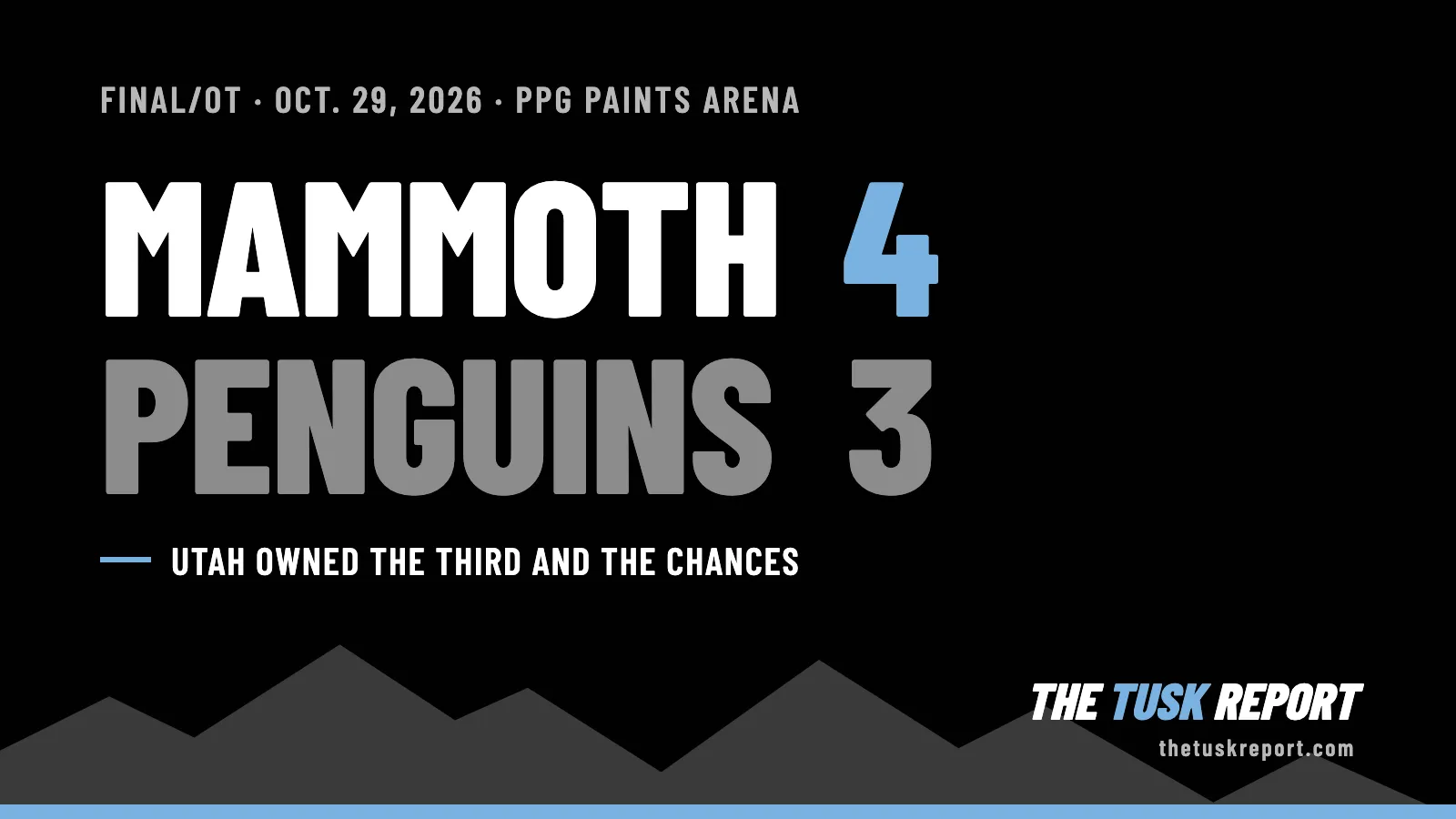
Our preview asked whether Utah's power play could score on a Pittsburgh penalty kill that hadn't allowed a goal at home. It couldn't, and it nearly cost Utah the game. Utah got one power play, not the two or three we expected. In its two minutes it had two shot attempts, no shots on goal, and Rickard Rakell scored shorthanded 61 seconds in to tie it 2-2. Pittsburgh's kill is now 12-for-12 at home by our count. We picked Utah 3, Pittsburgh 2, and the final was Utah 4, Pittsburgh 3 in overtime, so we got the winner right and the reason wrong.
The part we got right was the warning. We said the pick was in trouble if Utah was shorthanded four or more times again. It was shorthanded once, for Clayton Keller's hooking minor 49 seconds in, two days after taking seven minors against Minnesota. Pittsburgh had more of the puck for most of the night. Utah had the better looks at the net, owned the third period, and never gave the Penguins' power play a second chance, and that's how it won a game it led for 46 minutes and still needed a goal with one second left to save.
Dan Kingerski of Pittsburgh Hockey Now saw the same game from the other bench. In his reading, the Penguins had the puck and the shots until the middle of the third period, but Utah got the better chances, and he wrote that "the Penguins again gave a superior opponent more chances than they themselves could create" and that they "were fortunate to get a point, even if they were one second from winning."
Pittsburgh had the puck, Utah had the looks
At five-on-five this was close to even. The goals were 2-2, Pittsburgh outshot Utah 29-28 and out-attempted it 56-51, by our count of the NHL play-by-play. Utah led from Logan Cooley's first goal at 4:40 of the first period to Rakell's at 10:59 of the third, 46 minutes and 19 seconds of clock, and from the opener to the end of the second period Pittsburgh out-attempted Utah 34-28 at five-on-five. The Penguins also had the start, 9-1 in five-on-five attempts before Cooley's opener.
Then Utah took the third over. It out-attempted Pittsburgh 16-4 at five-on-five in the first 10:59 of the period, before Rakell's goal, and 21-13 for the whole period, with a 12-7 edge in five-on-five shots on goal.
Utah also shot from closer all night. At five-on-five, its average shot on goal came from about 28 feet and Pittsburgh's from about 36. Counting every strength, including the extra-attacker finish and overtime, Utah had 16 shots on goal from 25 feet or closer to Pittsburgh's 12, and its average shot on goal came from about 27 feet to Pittsburgh's 35.
The second period was Pittsburgh's, and the Mammoth don't argue it. Mikhail Sergachev called it "a muddy game" and said, "In the third period, I thought we played a lot better than the first two," in the team's game story. Pittsburgh outshot Utah 14-8 in the second, all of it at five-on-five, and that's where the Cossa story came from: through the middle of the game Penguins writers and fans were saying Sebastian Cossa was holding Utah up. Six of those 14 shots came from 40 feet or farther, and four from 25 feet or closer, one of them right on the line. Cossa stopped 31 of 34, a .912 save percentage, and his season number climbs from .820 to .857 (72 of 84). Twelve of the 34 shots he faced came from 40 feet or more, though. We'd call it a solid night behind a team that kept Pittsburgh outside.
Where Cooley shot from
Cooley, who was born in Pittsburgh, scored three goals on five shots on goal, from about 26, 15 and 7 feet. As Brogan Houston noted in the Deseret News, he went the first seven games of the season without a goal. He has seven in the seven since, on 16 shots, and it was his fourth career hat trick, per NHL.com.
Penguins coach Dan Muse described how Utah hurt his team, to Pittsburgh Hockey Now: "a lot of speed coming through the middle of the ice, which, you know, got us." The first goal came four seconds after the play-by-play logs an Erik Karlsson giveaway, unassisted, at 4:40. The second, at 14:11, was from about 15 feet after he split Karlsson and Spencer Stastney, per NHL.com, with assists from Lawson Crouse and Andrew Peeke, who was playing his 400th NHL game. Sergachev went further. "He had this inner Connor McDavid in him today," he said in his walk-off interview, per Houston.
Cooley was also part of the one bad minute. He drew Karlsson's tripping minor at 9:58 of the third, and on the power play that followed, the puck got past him at the point, per NHL.com's Wes Crosby, and Rakell went the other way to tie it.
The third goal came after Kindel, in his first game back from his Oct. 20 medical scare, put Pittsburgh ahead 3-2 with 25 seconds left. Cossa stopped Kindel from about 33 feet and Evgeni Malkin from about 5, and Kindel scored from about 6 feet, all inside two seconds. Utah used its timeout. With Cossa on the bench for an extra skater, Vincent Trocheck had a shot blocked at 19:54, then got one through from about 45 feet at 19:57. Cooley knocked the rebound in from about 7 feet at 19:59, with one second left, batting it out of the air with his backhand, as Wes Crosby described it. The league logs it as a tip-in, with assists from Trocheck and Keller. By NHL.com's count, it was the 10th game in league history, regular season or playoffs, where teams traded a go-ahead goal and a tying goal in the last 30 seconds of regulation, and the first since 2015.
The rest of it
Overtime lasted 3:27. Cooley hit the left post at 2:53. Barrett Hayton put a shot on Arturs Silovs at 3:24, and Sergachev scored from about 16 feet three seconds later, his fourth of the season. He played 26:16, the most of anyone in the game, and blocked five shots, the most on either team.
Artem Duda, in his NHL debut, played 15:17 and had four shots on goal, the most of any Utah defenseman. "He did not dip his toe; he did not hesitate," coach André Tourigny said in the team's game story. Utah won 32 of 57 faceoffs.
Silovs, who came in with a .922 save percentage at home, stopped 30 of 34, and Kingerski graded him an A+ for the chances he faced. Our distance count backs him: 16 of the shots Silovs faced came from 25 feet or closer, against 12 for Cossa.
What it changes
Utah is 9-5-0 with 18 points, second in the Central, three behind Minnesota, which has played one more game. By our count from the preview's numbers, it's now 6-1-0 when shorthanded three or fewer times and still 3-4-0 when it's four or more. One fan in the r/Utah_Hockey postgame thread wrote, "It should NOT have been that close." We agree, and the blame sits on about 86 seconds: the 61 of the power play and the last 25 of regulation. Thursday backs what Tuesday suggested: when Utah stays out of the box, it can take a road game over late even on a night the other team has the puck.
The power play is the open question. It went 12-for-28 on the road before Thursday, and in Pittsburgh it got two minutes and gave up a goal. Next is Philadelphia on Sunday (schedule), game two of six on the road.
Tusks up.
Sources: NHL box score, play-by-play, standings and player data (Duda's debut, Cooley's birthplace and game log). Shot attempts and shots by score state, period and strength, shot distances (approximate, from the NHL's coordinates) and Pittsburgh's home penalty-kill count are our counts from the NHL's data. Wes Crosby, NHL.com recap (Peeke's 400th game, Cooley's fourth hat trick, the late-goals note); Brogan Houston, Deseret News; Dan Kingerski, Pittsburgh Hockey Now; Catherine Bogart, Utah Mammoth game story; r/Utah_Hockey postgame thread. Our preview and Wild recap.