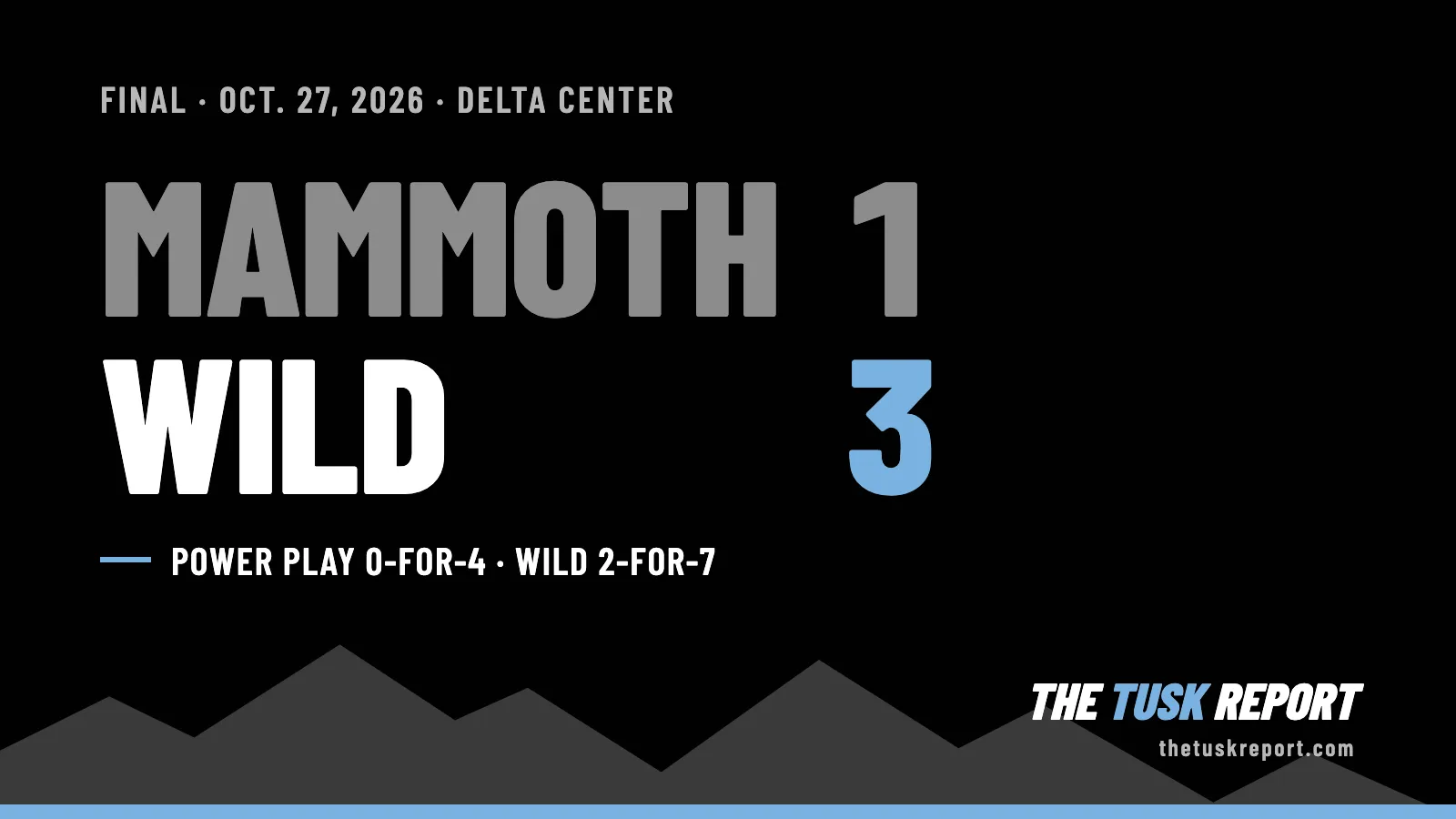
Utah fixed the problem our preview worried about and lost anyway. For the first time in five games, nobody scored on the Mammoth in the first six minutes, and the first period finished 0-0. Minnesota still scored first, on a power play at 15:04 of the second, which is exactly how we said our pick would go wrong. We had Utah 3, Minnesota 2. The final was Wild 3, Mammoth 1. Minnesota is now 7-0-2 when it scores first, and Utah is 3-5-0 when the other team does, by our count from the NHL play-by-play.
A lot of the r/Utah_Hockey postgame thread went to the officiating. We side with the fan who kept it short: "We can’t win a game when we commit 7 penalties." André Tourigny got to the same place. "I think the big story, for me, is the number of penalties we got," he said in the Mammoth's game story on NHL.com. So the penalties aren't in dispute. Our read the morning after is that they cost Utah more than two power-play goals. They took most of the second period away, and the kill Tourigny called solid wasn't.
Eight minutes short
Utah took seven minors to Minnesota's four, per the league's penalty list. The Wild went 2-for-7 on the power play and Utah went 0-for-4. Counting from the penalty times, Minnesota had 8:09 with the man advantage and Utah 3:48, 39 seconds of that at four-on-three. Utah's first power play lasted 16 seconds, the gap between the end of Lawson Crouse's slashing minor and the end of Joel Eriksson Ek's roughing minor. "The first power play was 15 seconds. It counts on the stat sheet, but it wasn't really a power play," Logan Cooley told The Hockey News.
Utah came in with the NHL's best power play, 16-for-42 and 38.1 percent by the league's team stats before Tuesday, and got seven attempts and one shot on goal. Minnesota got 18 attempts and seven shots on goal at five-on-four, four of those seven from 25 feet or closer.
Tourigny didn't see a problem with the kill. "Our PK was solid. You’ll tell me we gave up two goals (on the penalty kill); (Minnesota) had to take a perfect shot to score their first goal. The second goal, we blew a tire," he said in the Mammoth's game story. He has the first goal right. Eriksson Ek's one-timer from about 34 feet went in off the right post, by the Wild's recap on NHL.com. "Our PK was solid" doesn't hold up. Utah's kill came in 29th at 66.7 percent, and Tuesday it let a third puck in: Ryan Hartman's goal at 7:21 of the second, during Andrew Peeke's holding minor, was waved off after a video review found he kicked it in, per the same NHL.com recap. We'd call seven shots on goal in 8:09, four from in close, plus a goal it took a video review to wipe out, a kill that got lucky once.
The minor that became the winner
At 17:47 of the second, Clayton Keller got a tripping minor and an abuse-of-officials minor together. Brogan Houston of the Deseret News called the trip "debatable," and the thread was harsher. We won't argue the trip. Houston also wrote that the extra penalty led to Minnesota's game-winner, and the clock agrees. Without it, Keller's minor ends at 19:47 of the second, Danila Yurov's roughing minor from 18:15 runs out 15 seconds into the third, and 0:48 of the third is five-on-five. With it, Keller was still in the box when Kirill Kaprizov's wrist shot from about 36 feet, from Matt Boldy and Quinn Hughes, made it 2-0. It was Kaprizov's 14th goal of the season, the most in the NHL.
"I’ve got to lay off the refs," Keller told the Deseret News. Tourigny backed him without excusing it. "Surely, I want him to control his emotion and I don’t want that penalty. But if you look at all the circumstances (that) lead to that, I think we were all frustrated," he told the Deseret News. Keller still took three minors (he also high-sticked at 9:17 of the second) and Crouse two, so five of Utah's seven came from Keller and Crouse.
The period Utah didn't get to play
Tourigny's fuller answer in the game story explains the hole in the middle of this game: "From the end of the first period until the third period, we did not have one time where we could go with our four lines one after the other. That was a lot of guys that could not get into their rhythm." The penalty clock backs him. Only 7:34 of the second period was played at five-on-five, Minnesota had the man advantage for 7:20 of it, and in those 7:34 at full strength Utah had four shot attempts and one shot on goal. A fan in another r/Utah_Hockey thread saw the same thing: "at times when they didn’t have a player in the box they looked good."
The NHL's shift chart shows who paid for it. Liam O'Brien, in his first game of the season, fought Michael McCarron at 13:01 of the first and didn't take another shift until 3:13 of the third. Anders Lee, Jack McBain and Kailer Yamamoto each played between 2:49 and 3:03 in the second. "He did what he had to do. But then, he was a victim of the circumstances. He didn't play for a full period," Tourigny told The Hockey News about O'Brien.
The fights weren't the problem. Mikhail Sergachev and Boldy went at 14:29 of the first and Vincent Trocheck and Yurov at 18:15 of the second, and every major offset, so none of the three changed the manpower. Per Mammoth PR in the team's game story, it was the first three-fight game in franchise history, and Utah's eight fights this season are the most in the NHL. Minnesota liked the night just as much. "Guys had three fights, a few scrums. That's what we needed," John Hynes said in the Wild's NHL.com recap.
Tourigny's explanation covers the second period, though, not the first. The first had 17:44 of five-on-five, the most of any period, and Minnesota outshot Utah 11-5 in it at five-on-five. Hynes credited his team's "puck decisions" in the NHL.com recap, and Minnesota had five takeaways to Utah's one. Utah won 44 of 71 faceoffs, 62 percent by the NHL's game stats, and still spent 40 minutes chasing the puck.
The third, with nobody in the box
The third was the only period without a single penalty, and Utah outshot Minnesota 18-7 in it. Tourigny said in the game story that Utah "played better in the third period where we had an opportunity to get going." That's part of it. The score is the other part. Minnesota led by two or three goals for all of the third except the first 48 seconds, and teams with that lead sit back. Thirteen of Utah's 18 shots on goal came at five-on-five and five at six-on-five after Vejmelka went to the bench at 17:14, and 11 came from 25 feet or closer. Cooley scored at 18:39 with the extra skater, from about four feet: Nick Schmaltz deflected Sergachev's point shot and the puck came off the left post to Cooley, by NHL.com's account. It was his fourth goal of the season and, per Mammoth PR in the game story, the second extra-attacker goal in franchise history.
Jesper Wallstedt's 26 saves on 27 got him the second star, though Utah put only nine shots on him in the first two periods, three from in close. Cooley gave Minnesota's skaters credit too. "Props to them; they blocked a ton of shots on the PK and five-on-five," he said in the Mammoth's game story. About a third of Utah's shot attempts were blocked.
The fans who stuck up for Karel Vejmelka had it right, and Tourigny said in the game story he's happy Vejmelka is "back on track." He made 27 saves on 30. The two power-play goals came from the mid-30s in feet. Maxim Shabanov's five-on-five goal at 11:44 of the third, the 3-0 goal that ended it, came from about 22 feet, two seconds after the play-by-play logs a Dmitri Simashev giveaway. We've argued Utah should keep riding Vejmelka, and Tuesday didn't move us.
What it changes
Utah is 8-5-0 and Minnesota 9-3-2, with three meetings left, the next on Nov. 25 in St. Paul. The early-goal problem took a night off and a penalty problem showed up in its place. A team whose kill was 29th coming in can't give Kaprizov and Hughes seven power plays. A team that wants to roll four lines, as Tourigny says his does, can't spend more than 12 minutes of a period with somebody in the box.
Next is a six-game road trip that starts in Pittsburgh on Thursday and Philadelphia on Sunday (schedule). The minors, and the second period they cost, are what Tourigny has to fix by Thursday.
Tusks up.
Sources: NHL box score, play-by-play, shift chart and game stats (power plays 2-for-7 and 0-for-4, faceoffs). Shot attempts, shots by strength and period, shots from 25 feet or closer (distances approximate), records when scoring first, time at each strength from the penalty times, and ice time by period are our counts from the NHL's data. Season power-play and penalty-kill numbers from the NHL's team stats before the game. Quotes from Tourigny, Keller and Cooley and the Mammoth PR notes from Catherine Bogart's game story on NHL.com; Brogan Houston, Deseret News; The Hockey News (via Yahoo Sports); the Wild's recap on NHL.com (Hynes, Hartman's disallowed goal, Cooley's goal). Fan reaction from r/Utah_Hockey's postgame thread and a second thread. Our preview and Vejmelka post.